

Navigation
- What are the different fetal positions?
- Why is the left side of the uterus often the best?
- Why the posterior fetal position can be problematic for labor and delivery
- How can I tell what fetal position my baby is in?
- What can I do to encourage my baby into the correct fetal position for labor and birth?
- Breech position
- Signs of fetal malposition during labor
- Ways to help a malpositioned baby during labor
- My labor was classed as ‘failure to progress’
- FAQs
Did you ever wonder why some births speed along like a runaway train and others putter, stall and petter out?
One main factor can be the baby’s position (fetal position).
Birth is a marriage of efforts by both the person in labor and the baby. The cervix opens as the baby’s head pushes against it with each powerful contraction.
You can visualize this action by picturing the cervix as a turtleneck sweater through which the head slowly emerges. Ideally, to push the cervix open most effectively, the baby’s chin is tucked toward the chest, and the smallest, most malleable part of the baby’s head (posterior fontanel) presents first.
However, sometimes the baby is facing backwards (posterior), the baby’s head is tipped with the ear leaning towards it’s shoulder (asynclitic) or the baby’s head is extended away from the chest which results in the diameter of the head measuring larger. Also the side and back of the head won’t naturally mold the way the fontanel will and this can slow labor down.
What are the different fetal positions?
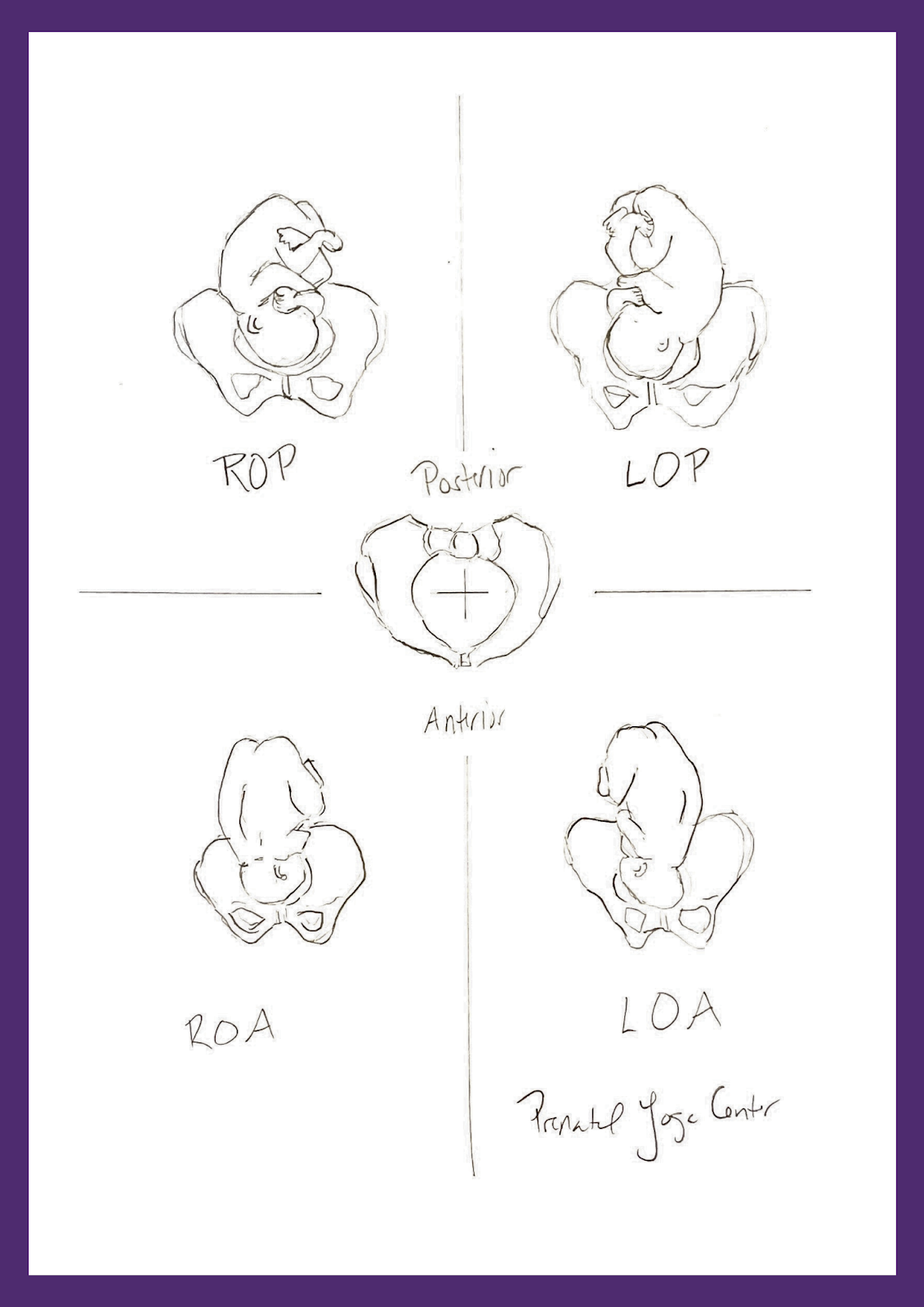
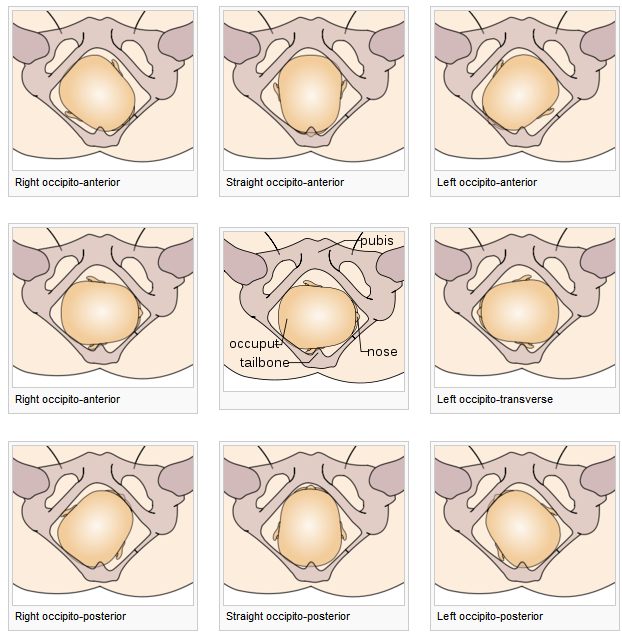
LOA- Left Occiput Anterior- the baby’s back is towards the parent’s left front side.
OA- Occiput Anterior – the baby’s back is towards the parent’s front body.
ROA- Right Occiput Anterior- the baby’s back is towards the parent’s right front side.
OT- Occiput Transverse- the baby’s back is to the parent’s side.
OP-Occiput Posterior – the baby’s back is towards the parent’s back.
ROP- Right Occiput Posterior- the baby’s back is towards the right side of the parent’s back.
LOP- Left occiput posterior – the baby’s back is towards the left side of the mother’s back.
Why is the left side of the uterus often the best?
The uterus is not symmetrical. The right side is steeper than the left which is more rounded. When a baby is nestled into the left side, the chin is flexed, or tucked deeply into its chest, presenting the smallest part of the baby’s head to descend downward into the pelvis.
When the baby is on the right side, because of the steeper angle, the baby’s chin may move away from its chest. This could make birth more difficult.
To understand the different fetal positions and how they impact birth and labor check out the video below that I made.
Why the posterior fetal position can be problematic for labor and delivery
A baby presenting in a posterior fetal position can lead to a host of issues. Dilation and progression usually take longer, and some birthing people get “stuck” at a certain point. They may experience intense back pain because the baby’s skull is pressed up against their sacrum. They may also experience the urge to urinate during each contraction, because the baby’s forehead is pushed up against their bladder.
When the baby is in the OP or OT positions, the fontanel is not the presenting part. Instead, it is likely that part of the baby’s un-moldable forehead is pressing up against the cervix. Sometimes the baby’s back is in the anterior position, but the baby’s head is slightly asynclitic, meaning it is slightly kinked to the side. This is also going to create a bit of a problem in pushing the cervix open in a timely manner.
At times it is difficult to rotate a baby out of the posterior position, especially if the baby has entangled itself in the cord or is deeply engaged in the pelvis. There are yoga poses that are encouraged and discouraged during the last trimester to help the baby move into the ideal birthing position.
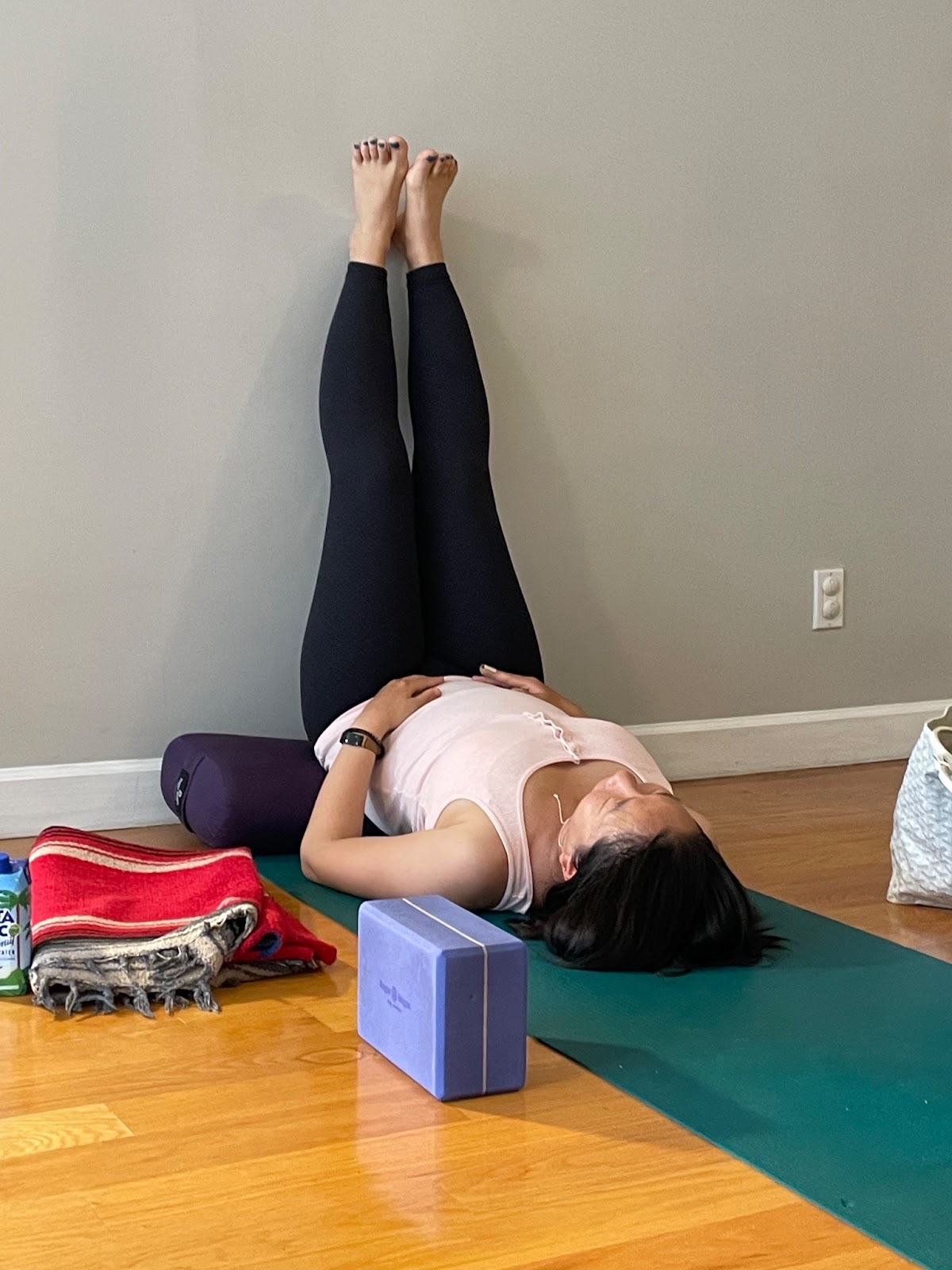
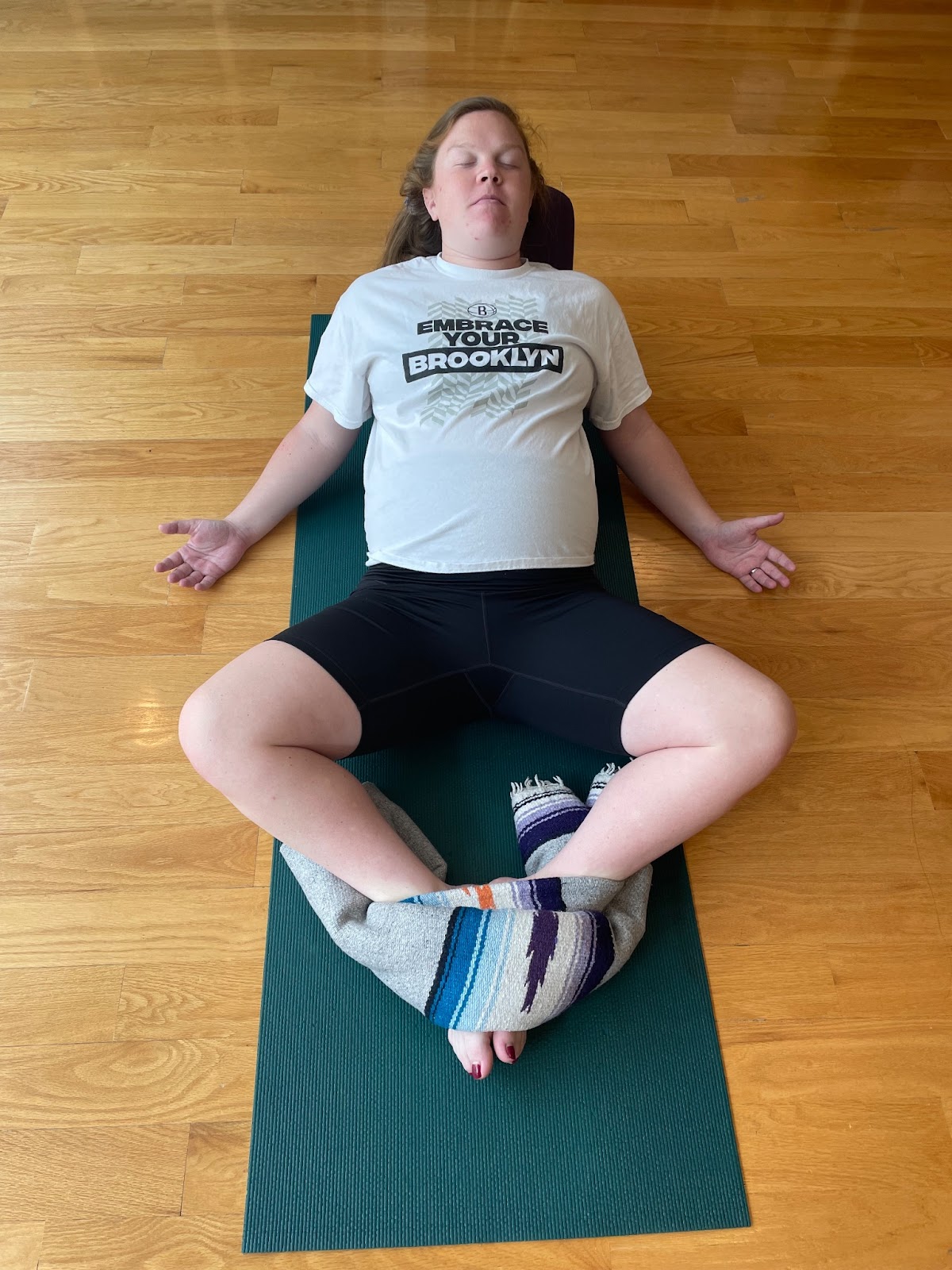
Specific yoga poses to omit from third trimester practice
- Prolonged Legs up the wall
- Supta Baddha Konasana (at the end of class)
- Supported bridge for a long period of time
How can I tell what fetal position my baby is in?
For some people it can be difficult to feel what is happening internally. In addition to not understanding the movements inside, some expectant parents are at a further disadvantage by having an anterior placenta (the placenta being adhered to the front of the uterus) making it even harder to feel the baby’s movements.
Start to pay attention to where you are feeling kicks and the shapes of your belly. Ideally, if the baby is situated towards the front of your body (LOA or ROA) position, you will feel kicks on one side of your belly. If your baby is in a posterior position with its spine towards your back, the kicks will be more towards the front of your belly. Visualize your baby inside your body, if the baby’s back is towards your back, then the feet will be more towards your front.
You can also start to palpate your abdomen. First, picture your baby’s body. If the head is down, then the landmarks you are looking for are a smooth round back, a hard butt and feet. Ideally, you will feel this along either the left or right side of your belly. If your baby is facing back, then you may not feel this. Your belly will also look a bit different. Picture your baby’s back towards your back. This will leave your belly having a bump at the top- where the legs are tucked in -a small depression around your belly button, and then another bump where the arms are hugging inward.
What can I do to encourage my baby into the correct fetal position for labor and birth?
If you suspect your baby is in a posterior position, there are things prenatally you can do to encourage your baby into a different position. Even if your baby is in an anterior position, doing these things will only encourage your baby to stay put.
Work on your posture and alignment
Start with being mindful of your posture and the way you position yourself in daily life. Our daily patterns create compensations in our bodies. Do you always cross the same leg or hold your bag on the same shoulder? These small repetitive habits slowly imprint on our bodies leaving one side stronger or tighter than the other. From years of carrying my bag on my right shoulder, it’s actually a bit lower than my left!
We know that the heaviest part of the baby is the back of the head and their back. So instead of coming home and throwing your feet up and sinking into the couch, which may draw your baby towards your back, lay on your side or rock on a birth ball which may invite your baby into the hammock of your belly.
Prenatal Yoga
Tight or torqued pelvic and uterine ligaments, misalignment in the pelvis, a tight psoas and tension in the pelvic floor can all lead to baby’s malposition and a stalled labor. The methodology we teach at Prenatal Yoga Center heavily centers on poses that encourage balance in the body so the baby has less obstruction on its way down and through the pelvis. We include poses that help create pelvic mobility, release tension in pelvic floor muscles and soft tissue and align the bony pelvis and spine.
Specific asanas for preparing the pelvis for labor and delivery:
- Baddha konasana (cobbler’s pose) Opens INLET
- Supported squats
- Unsupported squats- lengthen PF muscles and releases sacrum, but only if we know baby is in a good position!
- Upavistha Konasana (wide angle pose)
- Ankle to knee
- Virasana (hero’s pose)
- Child’s pose with a focus on breathing into the back ribs
- Prasaritta Padatanasana with downdog upper body (lengthen PF muscles and releases sacrum)
- 360 breathing
- The dangle to release the psoas
- Anjaneyasana
We do classes online and in person in our yoga studio in New York City. If you are trying to prepare your body for labor and birth as well as get your baby in the correct position, book a prenatal yoga class with us! Click the button below to book.
Alternative modalities
Other modalities I recommend to students are working with a pelvic floor physical therapist, having acupuncture, receiving the Webster technique with a prenatal chiropractor and doing a Spinning Babies session.
Swimming
Swimming is also a great activity to encourage your baby into the correct position as you often have your belly down while swimming which encourages the baby’s back towards the expectant parent’s back.
Breech Position
Another issue some face is the baby being in a breech position. This could mean the baby is standing straight up in the womb (footling breech), presenting butt first (frank breech), sitting cross-legged in the womb (complete breech) or the baby is kneeling inside (kneeling breech).
Regardless, very few doctors will deliver a breech baby vaginally. If a person finds out their baby is breech, they are often anxious to try to turn the baby around. Luckily, there are some yoga poses that can assist with this.
What you can do to move your baby out of breech position
Yoga poses to encourage breech baby to turn:
- “Butt up” child’s pose
- Supported bridge pose
- Right angle handstand at the wall ***advanced practitioners only
- AVOID squatting, as it opens the INLET of the pelvis and invites the baby to wedge itself deeper down
- The dangle and Anjaneyasana can be helpful to release psoas that may help baby turn
Beyond these specific yoga poses, as I mentioned before, acupuncture and chiropractic work have been known to help. You can also try placing ice at the fundus since the baby will likely move away from the cold. Or, you can place music or light down at the pelvic opening may encourage babies to head down as they are attracted to sound and light. I also recommend Spinning Babies sessions where a massage therapist can help to move the baby into the correct position.
In general, pregnant people should be mindful of the baby’s position as they near their due date and tailor their practice accordingly. Yoga can have a powerful effect on these last few weeks and days of pregnancy!
Please also note, that while inversions like butt up child’s pose, forward leaning inversion and any handstand can be helpful for many, there are contraindications as well.
Please do not invert if you have:
Heartburn
Glaucoma
High blood pressure
Suspected or known placenta issues or bleeding
High levels of amniotic fluid
If your baby has successfully turned from breech to head down.
*Please check with your care provider if you are unsure if inverting is right for you.
Signs of fetal malposition during labor
There are a number of indicators that show that your baby may be in a challenging position for labor and birth. Here are some of the signs.
Pain in the lower back or sacrum
One of the biggest indicators of back labor or fetal malposition during labor is a tremendous amount of pain in the back, mainly the sacrum area. This is not to be confused with the ordinary amount of back pain a laboring person may experience. Lingering pain on the sacrum area is often secondary to the pain of the contraction itself. This pain is due to the baby’s head pressing up against the bony structure of the pelvis.
A nonlinear labor pattern
In a functional labor, the contractions generally start out rather far about, 10-15 min or so lasting 30-60 seconds. As labor progresses, the contractions become stronger, longer and closer together, forming a predictable pattern and consistently 60ish seconds long. In a dysfunctional labor, contractions are more unpredictable. They may be 3 minutes apart with short painful contractions and then dropping back to 8 minutes apart.
Slow dilation or labor has stalled
The birthing person may be experiencing strong, frequent contractions with little progress and slow dilation or labor may have stalled completely.
Frequent need to urinate
Frequent need to urinate during/after contraction. This is due to the baby’s forehead pressing against the bladder which is under the uterus.
Checking the suture lines
If the cervix is open enough the care provider can feel for the suture lines to determine the position of the baby’s head.
Ways to help a malpositioned baby during labor
Once you have identified that the baby is malpositioned, there are ways to help adjust the baby. This often takes patience, time and effort. BUT it can work, so don’t give up hope!
Releasing tension
As mentioned before, sometimes tension in the muscles and ligaments can stall labor and distort the position of the baby’s head as it tries to move through the pelvis. You can try ‘shaking the apples’ and jiggling the hips and thighs, ‘Shaking the apples’ helps relieve tense muscles. If someone is unable to relax between contractions, the tension is going to accumulate in the muscles. ‘Shaking the apples’ is done by shaking the thigh and glute muscles. ‘Jiggling’ is done by releasing the fascia. This is a very gentle movement. Someone on your birth team would softly place their hands on your thighs and butt and softly jiggle.
Changing position during labor
Your baby may be rather engaged in the pelvis and actually need to be disengaged to help it properly rotate. You can do this in a “butt up child’s pose” or a forward leaning inversion. This is an effective way to float the baby’s head out of the pelvis and allow it to reposition itself.
Lay on your side in a semi-prone position with your bottom leg extended and top leg elevated on a peanut ball, pillows or a bolster. Roll towards your belly so your top hip is leaning forward. Take into consideration which side the baby’s head is facing. If the baby is ROP (right occiput posterior) then you should be laying on your left side. This will encourage the baby’s back towards your belly.
Hot water bottle or warm bath
A hot water bottle or warm bath can help relax the round ligament and broad ligament that may be pulling on the uterus.
Make more space for baby to rotate
If the baby is a bit more stubborn to move, you will likely want to work on positions that open the pelvis allowing for more space to rotate the baby- like lunges.
You can do this either standing on your knees.
Ways to make more space for the baby to rotate:
Side Lunges – Standing. Have your hips facing squarely forward and place a stool to your side. Externally rotate your leg and bring one foot up on the stool. Then lean into the lifted leg and then rock away. Keep repeating this action for at least 5 contractions. This will create an asymmetric opening of the pelvis and can help rotate the baby.
Kneeling – Similar to standing but you are on your knees.
Lying down – Use a peanut ball to support your top leg to open your pelvis. (See above for more details of how to position your body.)
Side walking up and down stairs – will also have the same effect of opening the pelvis.
Sidelying release – This is a technique I learned from Spinning Babies during my Spinning Babies Parent Educator Certification! This position makes more space for the baby and releases ligament and muscle tension. Here is the link to check it out!
Declining an amniotomy
If the baby is still malpositioned, DO NOT opt for an amniotomy (breaking the water). While it may sound enticing and hopeful that this intervention could possibly move labor along, the water still intact will give some cushioning and more ease in trying to rotate the baby. With the bag broken, the head may go further down in the WRONG position.
Epidural
Sometimes, an epidural can also assist in helping a baby to rotate. If the birthing person is exhausted and the pelvic muscles are tight and constricted, putting them into a relaxed state can allow the baby to move more easily.
Advocating for more time
Knowing that malpositioned babies take the longer to dilate, be prepared to push against preconceived ideas of labor progress. Seventy percent of cesareans are due to “failure to progress” which could be from poorly positioned babies. Ask “I am ok? Is my baby ok? Can we have more time?” These questions can possibly afford you more time to let your baby maneuver itself into a good position.
My labor could have been classified as as ‘failure to progress’
I would like to finish this blog post off on a personal note. When I was giving birth to my baby I could have easily been one of the seventy percent to have a c-section for failure to progress. However, I was very lucky as my midwife gave me the time (about 42 hours!) and tools to turn my baby so I could birth him vaginally.
If you find that your baby is not in an optimal fetal position, try some of the things that I have listed in this blog post to help move your baby into a better position. Even if you do find yourself in labor with a baby that is not in the optimal position for birth, it is still possible to move the baby into a better position. Try to find a birth team that is supportive and will help you to ask for the time and space that you need to have a successful labor and birth!
If you would like to book a prenatal yoga class with us to help move your baby into the correct position for birth, click below to book either an online class or an in person class in our yoga studio in New York City.
FAQs
What causes a baby to move into the wrong position?
There are a number of reasons why a baby might become malpositioned. It could be down to the posture and alignment of the parent or the parents habits. For example, lying with your feet up could encourage a posterior position. Or in some rare cases the umbilical cord can become entangled around the baby’s neck so the baby moves into a different position to relieve pressure on the umbilical cord.
How do I know if my baby has dropped into my pelvis?
If your baby has dropped into your pelvis (also known as lightening), your bump may look lower, you may feel more pressure in your pelvic region and you may find yourself ‘waddling’ when you walk. However, you may also find it easier to breathe with less pressure on your diaphragm.
What week does my baby need to be in the correct position for birth?
Usually at 32 weeks the baby is lying with their head downwards which is known as cephalic presentation. Most babies are in this position between the 32 and 36 weeks and ideally you would want them to get into a Left Occiput Anterior (LOA) position around this time.